Digital Video Broadcasting — Satellite (DVB-S)
| Broadcast | |
|---|---|
| Analogue Radio: AM radio - FM radio Digital Radio: DRM - DAB |
 | |
|---|---|
| Frequencies | 10700 MHz,12700 MHz |
| Frequency Range | 10700 MHz - 12700 MHz |
| Mode | ACM/VCM |
| Modulation | QPSK,8PSK,16APSK,32APSK |
| ACF | — |
| Emission Designator | — |
| Bandwidth | 100 kHz,72 MHz |
| Location | Europe, Asia |
| Short Description | DVB‑S and DVB‑S2 are both satellite broadcasting standards, but DVB‑S2 is a more advanced and efficient evolution of the original system. |
| I/Q Raw Recording | Download file |
| Audio Sample | |
DVB‑S is the first‑generation standard for digital satellite TV broadcasting. It was introduced in the mid‑1990s and defines how MPEG‑2 transport streams are transmitted over 11/12 GHzGigaHertz (GHz) 10^9 Hz satellite channels. It uses QPSKQuadrature Phase-Shift Keying (2 bits per symbol) modulation and a combination of convolutional and Reed‑Solomon coding to ensure reliable transmission. It became widely adopted by satellite operators for TV and data services.
DVB‑S2 (Digital Video Broadcasting – Satellite, Second Generation) DVB‑S2 is the second‑generation standard designed to improve efficiency, flexibility, and performance. It introduces more advanced modulation schemes such as QPSKQuadrature Phase-Shift Keying (2 bits per symbol), 8PSK8-Phase Phase-Shift Keying (3 bits per symbol), 16APSK, and 32APSK, along with stronger LDPC/BCH error correction. DVB‑S2 supports a wide range of applications including broadcasting, interactive services, and news gathering, offering significantly better spectral efficiency compared to DVB‑S.
Additional Images[edit]
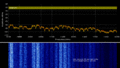
DVB-S2 TV multiplex channels over the satellite transponder (THOR)


